
Implants by a periodontology specialist
Dental implants in Antalya, Turkey
A dental implant is a small titanium screw placed in the jawbone that replaces the root of a missing tooth and carries a crown, a bridge or a full set of teeth. At Lumos, implants are planned on a 3D X-ray and placed by a specialist periodontist. Most patients need two short trips to Antalya, 3–6 months apart.
Medically reviewed by Uzm. Dt. Mehmet Ercan ·
- First trip
- 3–5 days
- Healing
- 3–6 months
- Second trip
- 5–7 days
- Anaesthesia
- Local
- Success rate
- 95–98 %
- Back to work
- Next day
How a dental implant works
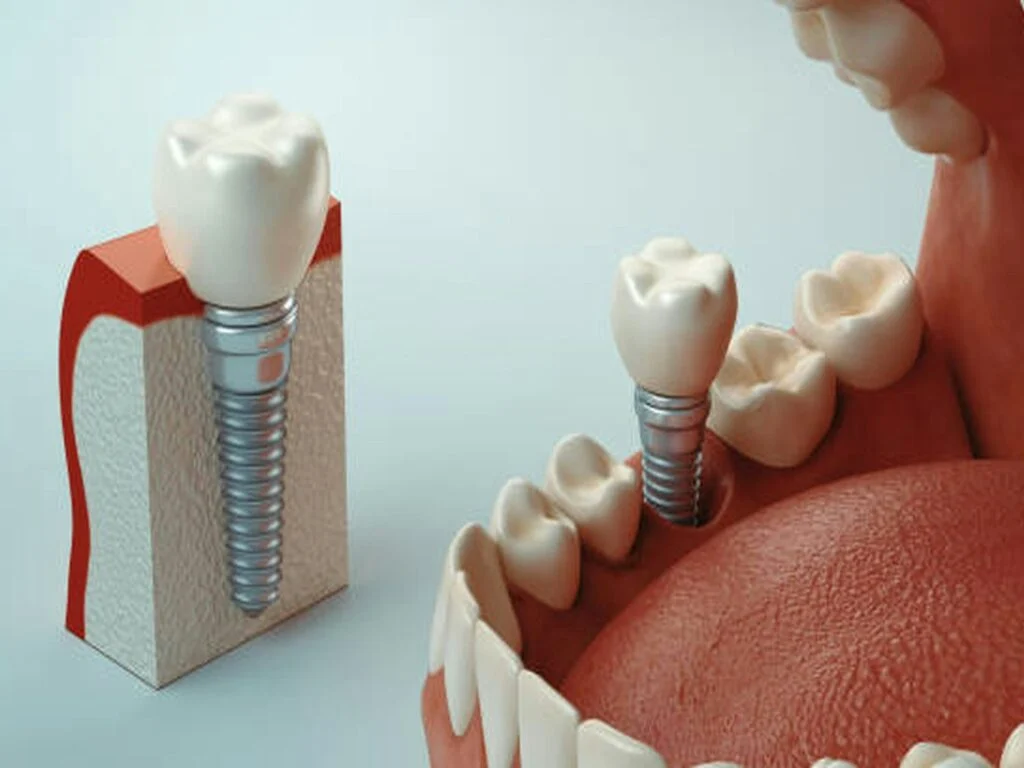
An implant treatment has three parts:
- The implant — a titanium screw placed in the jawbone. Over the following months the bone grows onto its surface (osseointegration) and holds it as firmly as a natural root.
- The abutment — a connector screwed onto the implant once it has healed.
- The crown — the visible tooth, made of zirconium or porcelain and matched to the colour of your other teeth.
Because the implant stands on its own, the neighbouring teeth do not have to be ground down as they would for a bridge. And because it loads the bone like a natural root, it helps stop the bone loss that follows tooth extraction.
Your treatment in Antalya, step by step
First trip: 3–5 days
- Day 1: examination, 3D cone-beam CT scan and final plan with your dentist.
- Day 2: implant placement under local anaesthesia (about 30–60 minutes per implant). Extractions and bone grafts can be done in the same session if needed.
- Day 3–5: check-up, stitches and a temporary tooth where the gap is visible.
Healing at home: 3–6 months
The implant fuses with the bone. You live normally; we stay in touch and you send us a photo or X-ray if your dentist at home takes one.
Second trip: 5–7 days
We take digital impressions, try in the crown or bridge and fit the final teeth.
Who can have dental implants?
Almost every adult in good general health whose jaw has finished growing (from about 18 years) can have implants. There is no upper age limit. What matters is the amount and quality of the bone and the health of the gums, which we check on the 3D scan.
We take extra care, and may ask for a letter from your doctor, if you:
- smoke — smoking increases the risk of implant failure; stop at least a week before and after surgery
- have diabetes that is not well controlled
- take blood thinners, bisphosphonates for osteoporosis, or have had radiotherapy to the head and neck
- have active gum disease — it must be treated first, which is exactly what a periodontist specialises in
Not enough bone? Bone grafting and sinus lift
After years without a tooth the jawbone shrinks. If there is not enough bone to hold an implant, it can be rebuilt with a bone graft, or in the upper back jaw with a sinus lift. Often this is done in the same session as the implant. When the bone is very thin, an All-on-4 solution with angled implants may avoid grafting altogether.
Implant brands and guarantee
We use implant systems from established Swiss, German and US manufacturers with long-term clinical studies and service networks in Europe, so your dentist at home can find parts if ever needed. The brand, the implant size and the serial numbers are written in your treatment report, together with the guarantee terms.
Aftercare: the first days after surgery
- Mild swelling and discomfort for 2–3 days is normal; ordinary painkillers are enough for most patients.
- Eat soft, lukewarm food for the first days and do not smoke or drink alcohol.
- Brush gently and rinse as instructed from the second day.
- Flying is fine the day after implant placement.
- Long-term: brush twice a day, clean between the teeth and see a dentist for a check-up and cleaning once or twice a year.
Why have dental implants in Turkey?
The same implant brands and the same procedure cost considerably less in Türkiye than in the UK, Ireland or Western Europe, mainly because of lower clinic running costs. What should matter most is who places your implant: at Lumos it is a specialist periodontist, whose training covers the bone and gums the implant depends on.
Price in Antalya
Fixed price after a free assessment of your photos
Included: consultation, 3D X-ray, airport and hotel transfers, written guarantee.
How it works
From the first photo to your new smile
- 1
Send your photos
Share a few smile photos or an X-ray through our form or on WhatsApp.
- 2
Get your plan and price
Our dentists reply within 24 hours with a personal treatment plan, a fixed price and how many days you need.
- 3
Fly to Antalya
We pick you up at Antalya Airport and drive you between your hotel and the clinic.
- 4
Smile, with aftercare
You fly home with a written guarantee and our team stays in touch for follow-up.
Dental implants: frequently asked questions
Does getting a dental implant hurt?
The surgery is done under local anaesthesia, so you feel pressure but no pain. Afterwards most patients describe the discomfort as less than a tooth extraction and manage with ordinary painkillers for 2–3 days.
How long do dental implants last?
With good oral hygiene and regular check-ups, studies show that 95–98 % of implants are still in function after 10 years, and many last a lifetime. The crown on top may need replacing after 15 years or more.
How many trips to Antalya do I need for implants?
Usually two: a first trip of 3–5 days to place the implants and a second trip of 5–7 days, 3–6 months later, to fit the final crowns or bridge. In some cases a single longer stay with immediate loading is possible.
Can I fly after implant surgery?
Yes. Flying is safe from the day after the implant is placed. If you had a sinus lift, we will tell you how long to wait and how to avoid pressure on the sinus.
What happens if an implant does not heal?
Rarely (in about 2–5 % of cases) an implant does not fuse with the bone. It is removed, the site heals and a new implant is placed. The conditions are part of the written guarantee you receive with your plan.
Can I have implants if I smoke?
Yes, but smoking roughly doubles the risk of implant failure and gum problems around implants. We ask you to stop at least one week before and one week after surgery, and ideally for good.
Patient reviews
What our patients say on Google
Related treatments
You may also be interested in
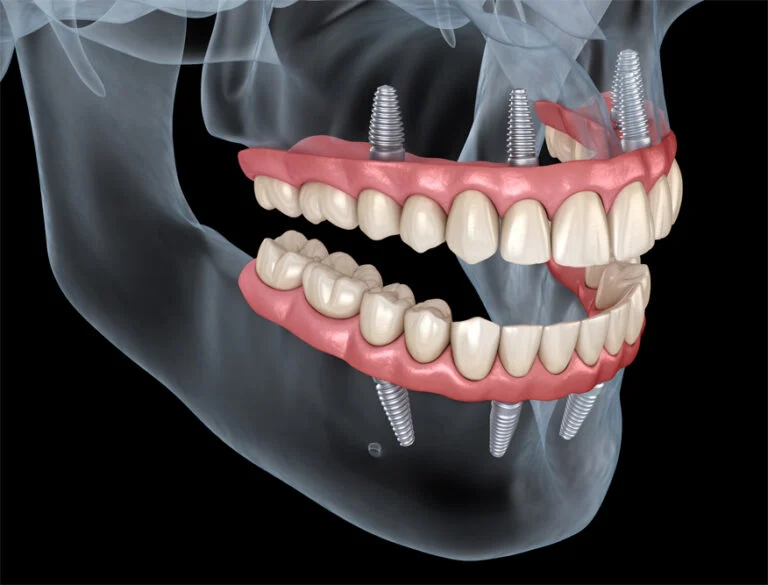
All-on-4 & All-on-6
A complete fixed set of teeth on four or six implants per jaw — for missing or failing teeth and loose dentures.Learn more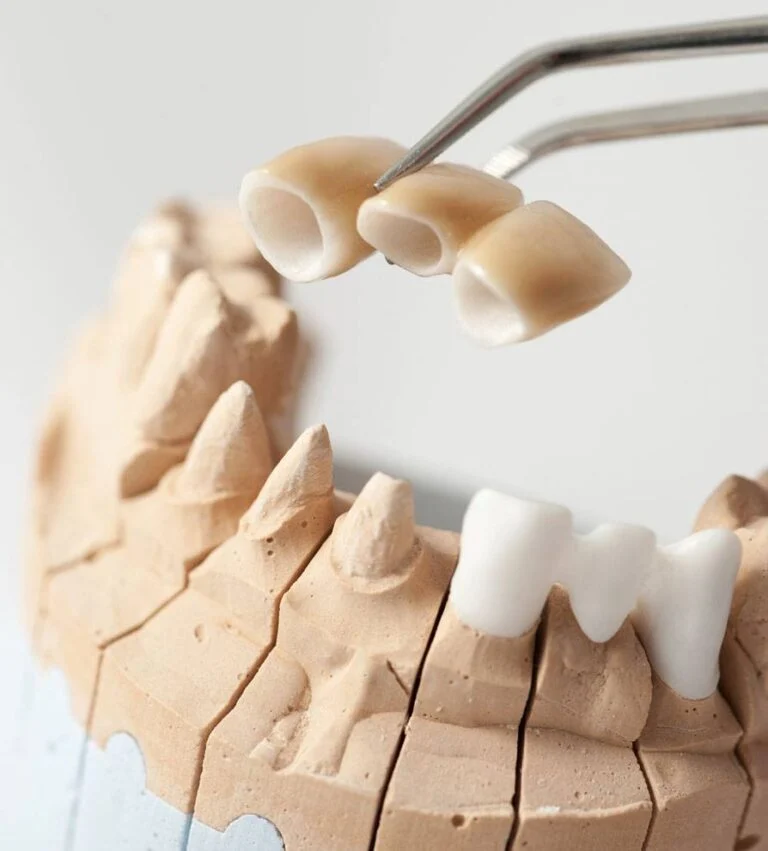
Zirconium crowns
Strong, metal-free crowns for broken, heavily filled or root-canal-treated teeth.Learn more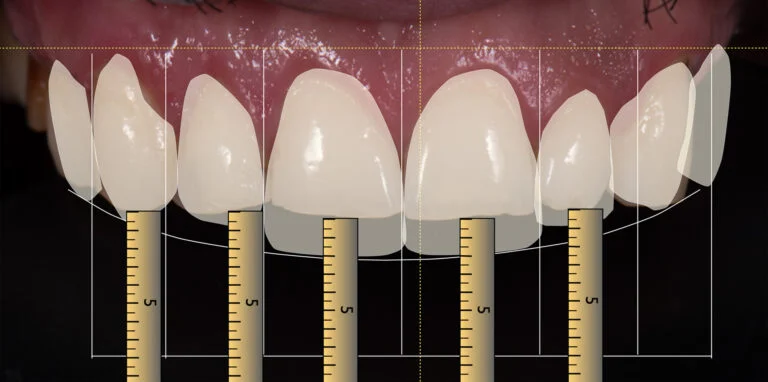
Smile makeover
A complete plan — whitening, veneers, crowns or implants — designed digitally around your face.Learn moreFree consultation
Get your personal treatment plan and price
Tell us what you would like to change and add a few photos. A dentist — not a sales agent — reviews your case and replies within 24 hours.
- Free and without obligation
- Fixed price in writing before you travel
- Reply in English, German, Russian or Turkish
- Your photos are used only for your treatment plan