
Removable teeth, on the gums or on implants
Dentures in Antalya, Turkey
A denture is a removable set of artificial teeth on a gum-coloured base. A full denture replaces all the teeth in a jaw, a partial denture fills gaps between your own teeth, and an overdenture clicks onto 2–4 implants for more stability. Making a denture takes several fitting appointments over about 7–10 days in Antalya; an overdenture also needs time for the implants to heal.
Medically reviewed by Uzm. Dt. Mehmet Ercan ·

- Stay in Antalya
- About 7–10 days
- Appointments
- Several fittings
- Types
- Full, partial, on implants
- Getting used to it
- Several weeks
- Relining
- When the fit loosens
- Lifespan
- About 5–10 years
Types of dentures
- Full (complete) denture — replaces all the teeth in a jaw. An upper denture covers the palate and is held by suction; a lower denture rests on a narrower ridge and moves more.
- Partial denture — fills gaps between your remaining teeth and is held by small clasps. The base is acrylic, a thin metal framework (cobalt-chrome) or a flexible plastic.
- Immediate denture — fitted on the day teeth are extracted, so you are not without teeth. As the gums shrink over the following 3–6 months it needs relining or replacing.
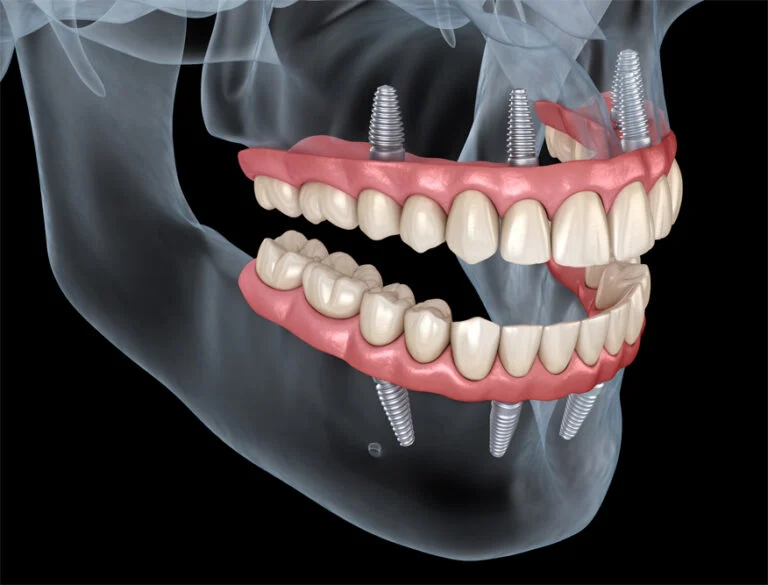
- Implant-supported overdenture — a denture that clicks onto 2–4 implants with ball, stud or bar attachments. You still take it out to clean it.
Who dentures suit
Dentures suit people who are missing many or all teeth and want a lower-cost option, people for whom implant surgery is not possible for medical reasons, and patients who need teeth while implants heal. A lower full denture is often the hardest to get used to, because it has little to hold on to; two implants make a large difference there.
Before a partial denture is made, decay and gum disease in the remaining teeth are treated, because the clasps rest on those teeth. If you want teeth that do not come out at all, look at bridges, implants or a fixed full-arch bridge.
Overdenture or All-on-4?
| Conventional denture | Implant overdenture | All-on-4 / All-on-6 | |
|---|---|---|---|
| Implants per jaw | 0 | 2–4 | 4–6 |
| Removable | Yes | Yes, by you | No, only by your dentist |
| Stability when chewing | Limited, especially below | Clicks in, much more stable | Fixed |
| Upper palate covered | Yes | Often less | No |
| Bone loss | Continues | Slowed around the implants | Slowed |
| Trips | 1 trip, about 7–10 days | 2 trips, implants heal 3–6 months | 2 trips: 5–7 + 5–7 days |
| Relative cost | Lowest | Medium | Higher |
For the lower jaw, a denture on two implants is a well-researched standard; the upper jaw usually needs four. A fixed All-on-4 bridge is screwed in and chews more like natural teeth, but it costs more and needs enough bone for 4–6 implants. Your dentist compares these options on the 3D scan.
Your appointments in Antalya
Conventional full or partial denture: about 7–10 days
- Examination, X-ray and first impressions.
- Precise impressions and a record of how your jaws meet.
- Try-in: the teeth are set in wax so you can check shape, colour and bite before the denture is finished.
- Fitting of the finished denture.
- One or more adjustment visits for sore spots before you fly home.
Laboratory work is needed between these steps, which is why they are spread over about 7–10 days. If teeth have to be extracted first, you receive an immediate denture or wait for the gums to heal; your plan states which and how long.
Implant overdenture: two trips
On the first trip the implants are placed under local anaesthesia. They heal for 3–6 months, during which you wear a denture that is adjusted so it does not press on them. On the second trip the attachments are connected and the denture is finished or adapted. Your plan states the number of days for each trip.
Getting used to a new denture
- In the first days you may produce more saliva and some words, especially those with “s” and “f”, can sound different. Reading aloud helps.
- Start with soft food cut into small pieces and chew on both sides at the same time.
- Sore spots are common in the first weeks. Do not adjust the denture yourself; a dentist can ease it in a few minutes.
- Most people feel comfortable after several weeks; a lower full denture often takes longer.
Daily care and relining
- Take the denture out and brush it every day with a soft brush and a denture cleaner or mild soap. Ordinary toothpaste is abrasive and scratches it.
- Clean it over a towel or a basin of water, so it does not break if dropped.
- Take it out at night and keep it in water or a cleaning solution, unless your dentist advises otherwise.
- Never use hot water, which can warp the base.
- Brush your gums, tongue and any remaining teeth, and with an overdenture the implant attachments.
Relining
Gums and bone change shape over time, so a denture gradually loosens. Relining adds new base material to the fitting surface; for many people this is needed every few years, and usually 3–6 months after extractions. Any dentist can reline a denture. The plastic inserts of overdenture attachments wear and are replaced when the denture feels loose. A denture itself typically lasts about 5–10 years.
Risks, disadvantages and cost
- Sore spots and ulcers, mainly in the first weeks or when the fit loosens.
- A fungal infection of the gums under the denture, more likely if it is worn at night or not cleaned well.
- Under a conventional denture the jawbone continues to shrink, so it becomes looser over the years.
- Chewing force is lower than with natural teeth, and an upper denture covering the palate can change how food tastes.
- Clasps of a partial denture collect plaque; poor cleaning can lead to decay and gum disease in the teeth that hold it.
- Overdentures add the risks of implant surgery and need regular maintenance of the attachments.
The cost depends on the type of denture and its material, the number of implants and attachments, and any extractions or gum treatment needed first. See prices.
How it works
From the first photo to your new smile
- 1
Send your photos
Share a few smile photos or an X-ray through our form or on WhatsApp.
- 2
Get your plan and price
Our dentists reply within 24 hours with a personal treatment plan, a fixed price and how many days you need.
- 3
Fly to Antalya
We pick you up at Antalya Airport and drive you between your hotel and the clinic.
- 4
Smile, with aftercare
You fly home with a written guarantee and our team stays in touch for follow-up.
Dentures: frequently asked questions
How long does it take to make a denture in Antalya?
Plan about 7–10 days for a conventional full or partial denture, with several fittings and laboratory work in between. An overdenture on implants needs two trips because the implants first heal for 3–6 months.
How long does it take to get used to a new denture?
Most people feel comfortable after several weeks. Speech usually settles within days; eating takes longer, and a lower full denture often needs the most patience.
Should I sleep with my denture in?
Usually not. Taking it out at night lets the gums recover and lowers the risk of fungal infection. Keep it in water or a cleaning solution so it does not dry out.
How many implants does an overdenture need?
In the lower jaw two implants are often enough. In the upper jaw usually four are needed, because the bone is softer and the denture is heavier against gravity.
What is the difference between an overdenture and All-on-4?
An overdenture clicks onto 2–4 implants and you take it out to clean it. All-on-4 is a fixed bridge screwed onto 4–6 implants that only your dentist can remove; it costs more and needs more bone.
Can my existing denture be attached to implants?
Sometimes. If your current denture fits well and is in good condition, attachments can be built into it; otherwise a new denture is made. Your dentist decides at the examination.
How often does a denture need relining?
Whenever it becomes loose, which for many people means every few years. After recent extractions the gums shrink faster, so a reline is usually needed after 3–6 months.
Patient reviews
What our patients say on Google
Related treatments
You may also be interested in
All-on-4 & All-on-6
A complete fixed set of teeth on four or six implants per jaw — for missing or failing teeth and loose dentures.Learn more
Dental implants
Replace one, several or all missing teeth with fixed teeth that look, feel and chew like your own.Learn more
Dental bridges
A fixed row of crowns that fills a gap, held by the neighbouring teeth or by implants.Learn moreFree consultation
Get your personal treatment plan and price
Tell us what you would like to change and add a few photos. A dentist — not a sales agent — reviews your case and replies within 24 hours.
- Free and without obligation
- Fixed price in writing before you travel
- Reply in English, German, Russian or Turkish
- Your photos are used only for your treatment plan